Overview
Why visit Basilica Cistern
The Basilica Cistern is among the most extraordinary historical sites in Istanbul and one of the finest surviving examples of Byzantine engineering. Hidden beneath the bustling streets of Sultanahmet, this vast underground reservoir has captivated visitors for centuries with its immense scale, elegant columns, mysterious atmosphere, and remarkable history. Unlike many of the city’s monuments that rise above the skyline, the Basilica Cistern invites travelers to descend into a hidden world beneath one of the most historically significant areas of Istanbul.
Constructed during the reign of Byzantine Emperor Justinian I in the sixth century, the cistern was designed to supply water to the Great Palace of Constantinople and nearby buildings. During a period when secure water storage was essential for the survival of the city, massive underground reservoirs were constructed throughout the capital. The Basilica Cistern became the largest and most impressive of these structures, demonstrating the advanced engineering capabilities of the Byzantine Empire.
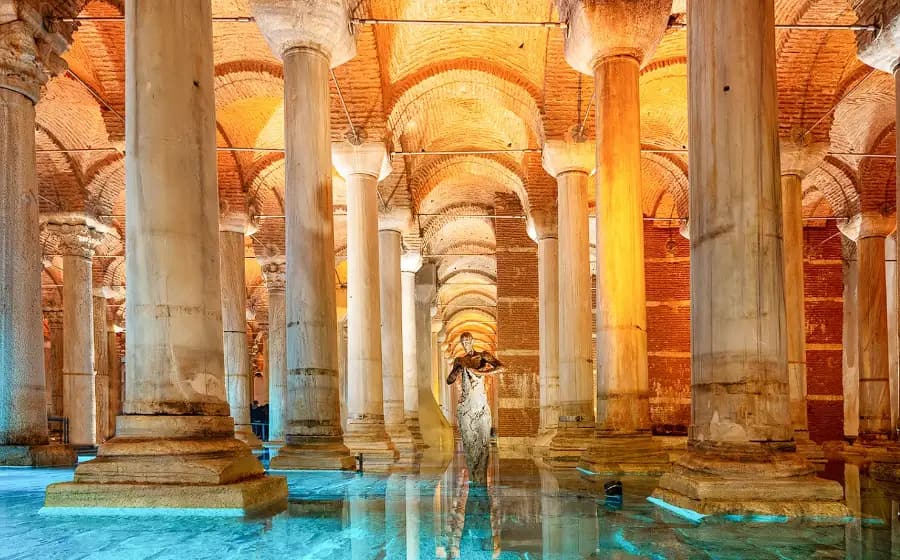
The cistern measures approximately 140 meters in length and 70 meters in width, creating a vast subterranean chamber capable of storing tens of thousands of cubic meters of water. Its ceiling is supported by 336 marble columns arranged in orderly rows, creating a striking visual effect that resembles an underground palace. This architectural grandeur is one reason why the structure became known as the "Sunken Palace" among local residents.
Upon entering the Basilica Cistern, visitors are immediately immersed in a unique atmosphere. Dim lighting reflects off the shallow water below, while the towering columns disappear into the shadows above. Gentle sounds of dripping water and carefully designed illumination enhance the sense of mystery and wonder. The experience feels very different from other historical attractions in Istanbul, offering a calm and almost otherworldly environment.
Many of the columns used in the cistern were repurposed from earlier Roman structures, resulting in a fascinating variety of designs and decorative styles. Some columns feature Corinthian capitals, while others display simpler forms. This reuse of architectural materials provides insight into the practical building methods employed during the Byzantine era and contributes to the cistern’s distinctive appearance.
One of the most famous features of the Basilica Cistern is the pair of Medusa head sculptures located at the base of two columns. These massive stone carvings, believed to have originated from an earlier Roman monument, are positioned in unusual orientations—one sideways and the other upside down. Their exact origin and purpose remain uncertain, adding an element of intrigue that continues to fascinate historians and visitors alike.
The elevated walkways allow visitors to explore the cistern comfortably while appreciating its impressive scale from different angles. Throughout the chamber, strategically placed lighting highlights architectural details and creates dramatic reflections on the water's surface. The result is one of the most photogenic and atmospheric interiors in Istanbul.
The Basilica Cistern has also gained international recognition through its appearances in literature, films, and popular culture. Its dramatic setting has served as a backdrop for numerous productions, introducing audiences around the world to this remarkable underground monument. These appearances have further enhanced its reputation as one of Istanbul’s most unique attractions.
Photography enthusiasts are particularly drawn to the cistern's visual appeal. The combination of ancient columns, reflections, atmospheric lighting, and historical details provides endless opportunities for creative photography. The Medusa heads are among the most photographed features, while the endless rows of columns create striking compositions throughout the site.
The attraction is suitable for visitors of all ages and interests. History enthusiasts appreciate its Byzantine origins, architecture lovers admire its engineering achievements, and casual travelers enjoy the immersive atmosphere. Its central location also makes it easy to include alongside nearby landmarks such as Hagia Sophia, the Blue Mosque, and Topkapi Palace.
The best time to visit is during the morning hours when visitor numbers are typically lower. Spring and autumn offer particularly pleasant conditions for exploring Istanbul’s historic district, although the cistern itself maintains a cool and comfortable environment year-round. Purchasing tickets in advance can help reduce waiting times during busy periods.
A visit to the Basilica Cistern provides a rare opportunity to experience a hidden chapter of Istanbul’s history. Combining engineering brilliance, architectural beauty, and centuries of mystery, it remains one of the city’s most unforgettable attractions and an essential destination for anyone exploring the historic heart of Istanbul.
Highlights
What stands out
Getting there
How to Go
The Basilica Cistern is located in Sultanahmet, within walking distance of Hagia Sophia and the Blue Mosque. Visitors can easily reach the site by tram, metro, taxi, or on foot from many central Istanbul attractions.
Before you go
Practical Info
Seasonality
Best Time to Visit
Year-round
On the ground
Travel Tips
- Visit early in the day to avoid larger crowds
- Bring a camera suitable for low-light photography
- Combine your visit with Sultanahmet’s major landmarks
- Purchase tickets in advance when possible
- Take time to view the Medusa heads from different angles
- Allow at least one hour to fully appreciate the site
- Wear comfortable shoes for walking on the platforms
FAQs
Common questions
The Basilica Cistern is a sixth-century underground water reservoir built during the Byzantine Empire beneath present-day Istanbul.
It is famous for its impressive underground architecture, atmospheric setting, and the mysterious Medusa head sculptures.
The cistern was commissioned by Byzantine Emperor Justinian I during the sixth century.
Most visitors spend between one and two hours exploring the cistern.
They are large stone carvings reused from earlier Roman structures and placed beneath two columns within the cistern.
Yes, photography is generally permitted, making it a popular destination for photographers.
Yes, the attraction is suitable for visitors of all ages.
Yes, it is located within walking distance of several of Istanbul’s most famous historical landmarks.